
Cherokee County Sex Offender Checks
The official starting point is Cherokee County's branded South Carolina Sex Offender Registry, often called SORT. SLED manages the data system, and the Cherokee County Sheriff's Office performs registration and verification in the county. The local portal offers both name and geographic searches. It is free and does not require an account. A person must accept the conditions of use and pass a CAPTCHA before the search controls appear.
Use a name search when the person is known. Choose the map or geographic route when the concern is tied to an address, ZIP code, or part of Cherokee County. Results may show both a mapped view and an alphabetical list. The marker and profile should be read together because the public record can distinguish a reported home location from another mapped point. For a search that extends beyond South Carolina, the U.S. Department of Justice national site is the better extra layer.
Note: Registry inclusion reflects a qualifying conviction or adjudication, not a forecast of a person's present conduct or risk.
Cherokee County SORT Entry Steps
The Cherokee portal puts lawful-use terms before the search. That order matters. Open the official Cherokee SORT conditions page, review the terms, accept them, and complete the verification code. Then select either Geographic Search or Name Search. Current versions of Edge or Chrome are recommended by the portal; its notice says Firefox and Safari can behave unpredictably.
The official conditions screen shows why the search does not open straight to names or pins.
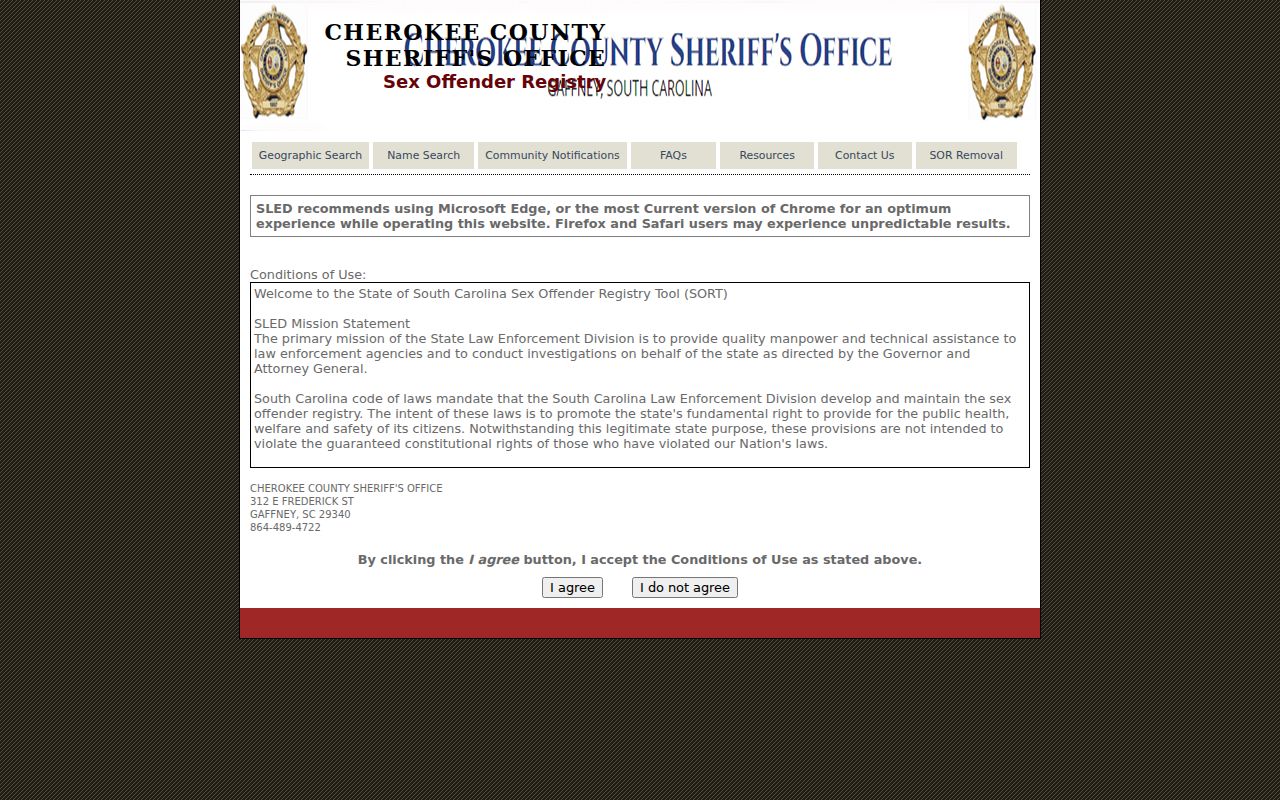
That front gate gives each Cherokee County registry user the same use limits before any public profile can be opened.
South Carolina Sex Offender Registry Searches
The statewide South Carolina Sex Offender Registry provides the same core search layer behind the county-branded route. It supports a direct name search and a geographic search built around an address with radius or a ZIP code. Exact radius options do not appear safely before the CAPTCHA, so users should select from the choices shown after entry rather than assume a distance.
- Open the official registry, read the conditions of use, and select the acceptance control.
- Complete the verification code, then choose Name Search or Geographic Search.
- Enter the name, address and radius, or ZIP details that fit the purpose of the check.
- Compare the list and map, then open the matching public profile to review its reported facts and status.
The official SLED registry search displays the available routes without relying on a private data broker.
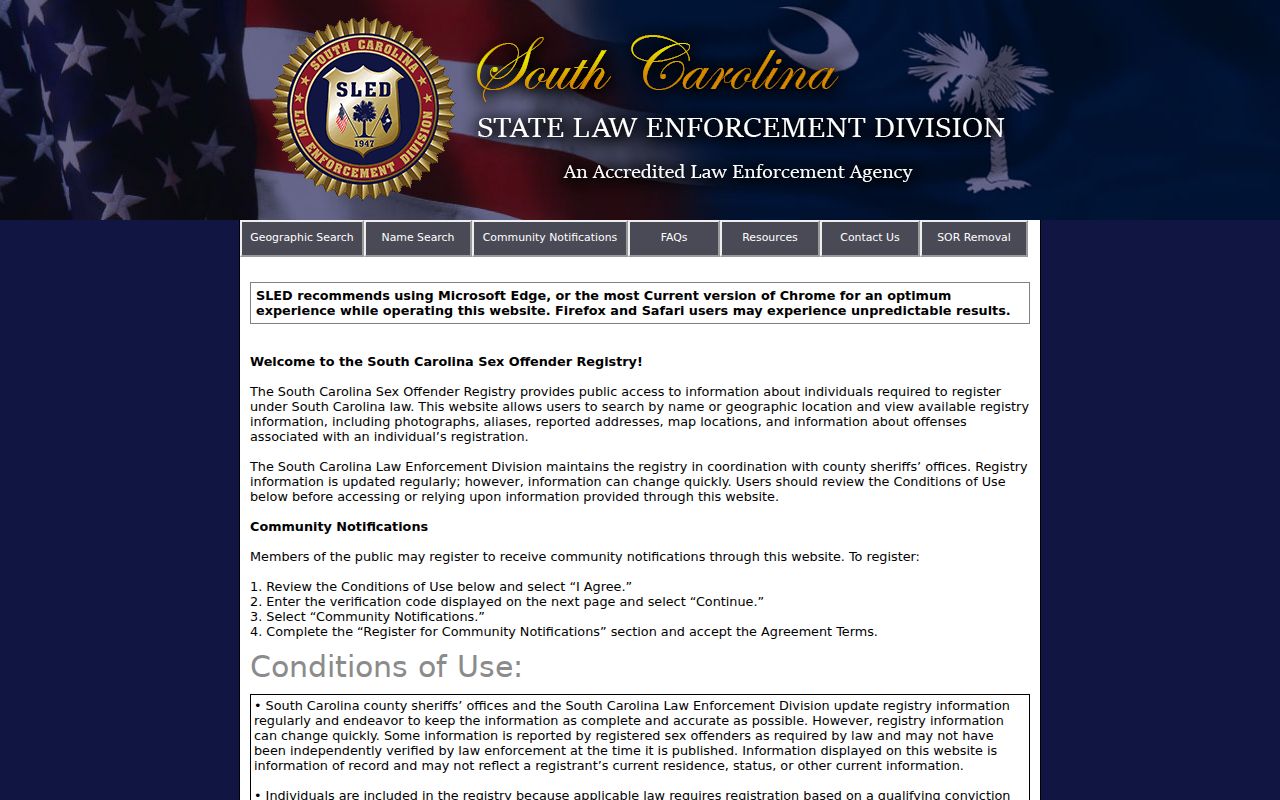
The search form keeps name and place queries distinct, which helps a Cherokee County user choose the right starting point.
| Search or Control | Type | Required | Options and Notes |
|---|---|---|---|
| Conditions of Use | Accept button | Yes | Accept the lawful-use terms first |
| Verification code | CAPTCHA and text | Yes | Continue after verification |
| Geographic Search | Search tab | One mode | Address with radius or ZIP |
| Address and Radius | Text and dropdown | For address search | Radius choices appear after entry |
| ZIP | Text | Alternative | Returns a geographic list and map |
| Name Search | Tab and text | Alternative | Returns a name-based list and map |
| Community Notifications | Tab and form | No | Separate signup and agreement |
Cherokee County Offender Registration
Registration is a local duty even though SLED runs the state database. A registrant must report to the sheriff in every county where that person resides, owns real property, works, or attends school. In Cherokee County, the registration contact is the Cherokee County Sheriff at 312 East Frederick Street in Gaffney. The published phone is 864-489-4722. The reviewed official sources did not publish set counter hours, an appointment rule, or a local fee, so calling first is sensible.
The sheriff collects much more than every visitor sees on a public profile. State law calls for items such as fingerprints, palmprints, vehicles, internet identifiers, and certain work, school, and travel information. That collection duty does not mean each field is released online. Public access follows the display rules and limits set by South Carolina law and SLED.
Cherokee County Sheriff
312 E. Frederick Street
Gaffney, SC 29340
864-489-4722
Registry Profiles: What They Show
A public SLED profile is built for identification and awareness. SLED confirms that it can show a photograph, aliases, reported addresses or map locations, and the associated offenses. Identity and physical descriptors plus registration or status context may also appear. Match more than a name. A shared name is not enough, and an address can change before an agency has finished checking a new report.
| Name and Aliases | Reported names used to distinguish the listed person |
|---|---|
| Photo and Description | A public image with available identity and physical descriptors |
| Reported Address | Published residence or map location subject to update and verification |
| Offense and Statute | The qualifying offense information associated with registration |
| Map Marker | A plotted point that may distinguish residence and work locations |
| Registration Status | Available status context, which should be checked for current meaning |
Some fields collected by law enforcement were not confirmed as public through the CAPTCHA-protected interface. Do not assume the profile will show vehicles, scars or tattoos, a school or employer, victim age, or every tier field. The distinction guards against treating a law-enforcement file inventory as a promise about public display.
Cherokee County Registry Notifications
Community Notifications is not turned on merely by running a map or name search. It has its own tab, registration form, and agreement. A Cherokee County resident who wants notice tied to an area must complete that separate signup. Returning to the search later does not replace enrollment in the notification tool.
South Carolina school-district notice is another channel. Districts provide an appropriate registry link or names and addresses of registrants within 1,000 feet of relevant school bus stops each year. That statutory notice is separate from the public portal's community alerts. Both can inform local awareness, but neither removes the need to check the current official profile before acting on an old alert or saved result.
Note: For suspected noncompliance, contact the Cherokee County Sheriff or SLED SOR; call 911 only for an emergency.
Registration Levels and Duties in South Carolina
South Carolina's state tiers describe the earliest route by which an eligible adult may seek removal. They do not set an automatic end date. Registration is for life unless a person receives formal removal. Most registrants reregister twice each year, while a person classified as federal Tier III reports every 90 days. Federal verification frequency and the state removal tier are different concepts.
| State Tier | Duration | Earliest Removal Route | Visibility and Reporting |
|---|---|---|---|
| Tier I adult | Lifetime unless removed | Apply to SLED after 15 years | Adult record is public; keep reporting through written approval |
| Tier II adult | Lifetime unless removed | Apply to SLED after 25 years | Adult record is public; reporting frequency is classified separately |
| Tier III adult | Lifetime unless removed | Petition General Sessions after 30 years | Adult record is public; reporting frequency is classified separately |
Adult registry information and juvenile Tier III information are public. Other qualifying juvenile information is limited to the requesters listed by law, while law enforcement retains access. This visibility rule is distinct from how often a person reports to the sheriff.
Cherokee County Registry Removal Review
Reaching 15, 25, or 30 years means a possible route opens. It does not erase a Cherokee County registry record. Tier I and Tier II adults apply to the SLED SOR Unit, which reviews eligibility, history, treatment information, and fingerprints. Tier III adults petition the Court of General Sessions after the stated period. Everyone keeps registering until written approval is issued.
The official SLED registry guidance describes the paper removal packet and process.
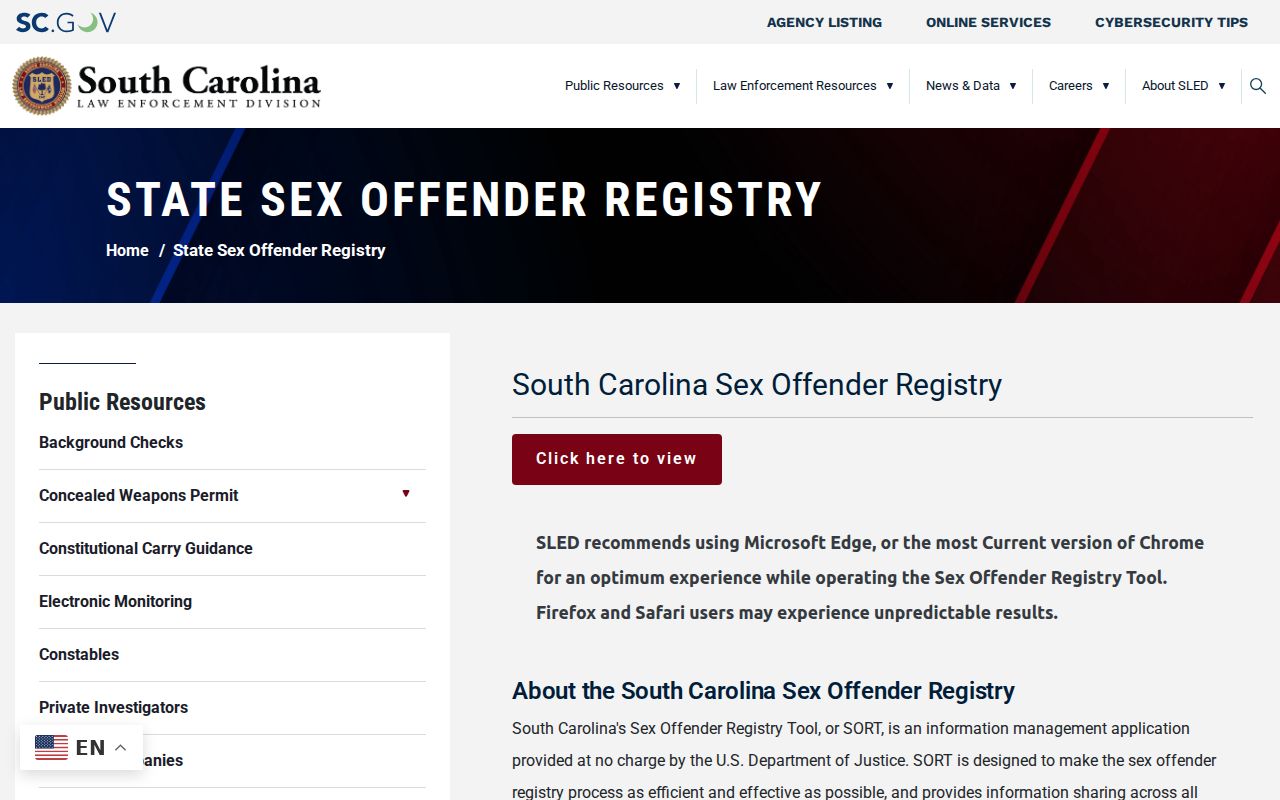
The state guidance is the source to check before assembling a Cherokee County removal request because the route and proof differ by tier.
The packet goes to SLED SOR Unit, P.O. Box 21398, Columbia, SC 29221. It calls for the completed application, two recent FD-258 fingerprint sets, disposition and treatment proof, and a $250 nonrefundable cashier's check or money order. SLED applies a 120-day process after complete receipt. After a denial, a new application cannot be made sooner than five years.
Cherokee County Offender Residency Limits
A pin on the Cherokee County sex offender map does not by itself answer whether an address violates the law. South Carolina Code §23-3-535 sets a 1,000-foot rule for specified child-victim offenses near schools, day care centers, children's recreational facilities, parks, and public playgrounds. The statute also contains exceptions and a measurement rule. The offense, the protected site, the date, and the statutory facts all matter.
Use the map to understand reported locations, not to make a legal ruling from screen distance. A marker may represent a residence or a work point, and a plotted symbol is not a survey. The official South Carolina registry chapter supplies the controlling terms and exceptions. Questions about a specific Cherokee County address should go to the sheriff or qualified counsel rather than to a visual estimate.
Cherokee County Registry Across States
The county and state portals are the best sources for South Carolina registration detail. A search should also move to the National Sex Offender Public Website when a name, prior place, or family safety concern crosses state lines. NSOPW searches participating jurisdictions through one federal entry point. It does not replace the originating registry, and coverage or displayed fields can vary among jurisdictions.
The U.S. Department of Justice national search is the official cross-state layer.
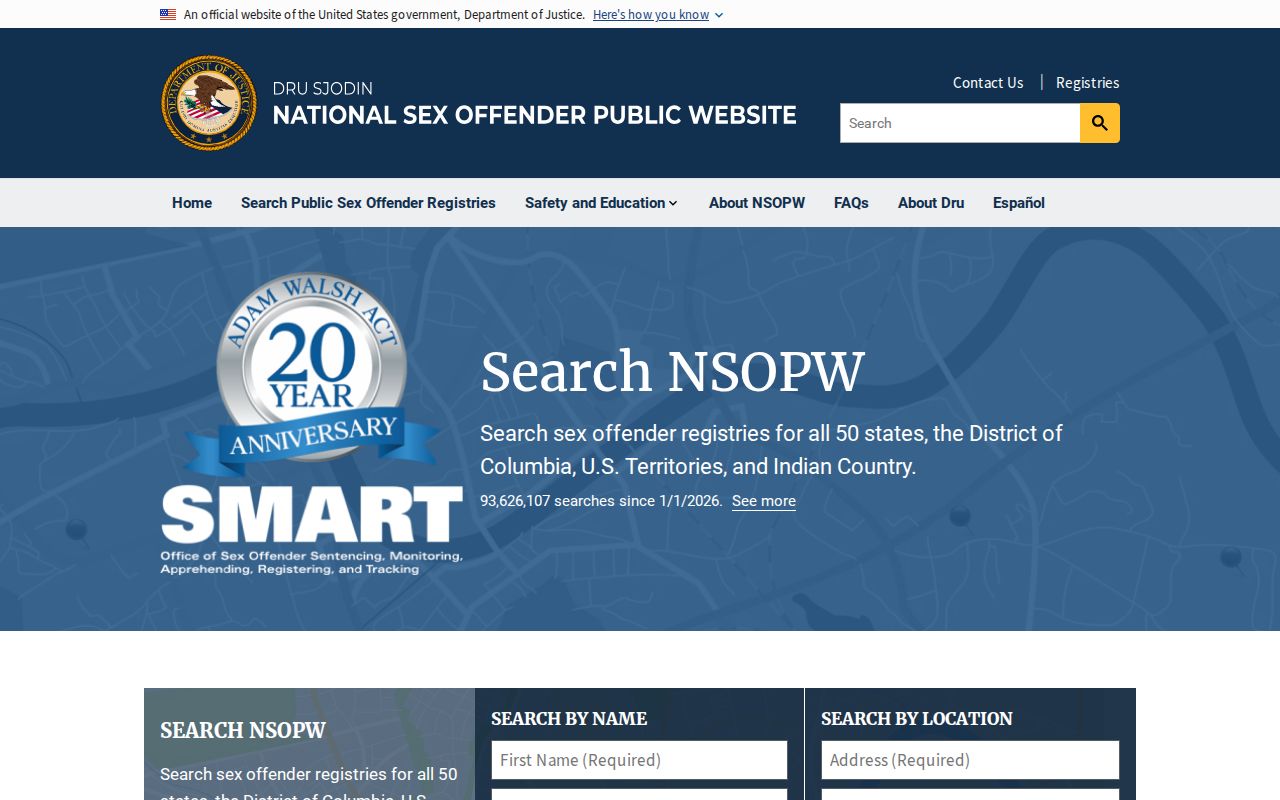
A national result should lead back to the listed state or territory profile for the latest local record and reporting context.
Start with Cherokee County SORT when the address and registration are local. Add the statewide SLED route for another South Carolina place. Use NSOPW if the search may involve another state, tribe, territory, or participating jurisdiction. That sequence keeps each finding tied to an official source.
Using Registry Information Lawfully
Registry access is meant for community awareness and sound safety planning. Read the listed offense, the reported location, and the current status without treating a profile as a prediction. Do not confront anyone at a mapped address. A reported location can change, and information supplied by a registrant may still await agency verification.
Misuse is a crime. South Carolina Code §23-3-510 can enhance punishment when registry information is used to commit another crime. Do not harass, threaten, injure, intimidate, or target anyone at a reported address.
The official statute raises a misdemeanor maximum to $1,000 or six months and permits felony imprisonment for up to five years when its conditions apply. Suspected failure to register should be reported to the Cherokee County Sheriff or SLED SOR. In an active emergency, call 911.