
Gaffney Criminal History Checks
Begin a Gaffney record check by deciding whether the needed fact is a police event, a Gaffney court case, a booking, or a broader state history. That choice matters. Gaffney Police controls its own incident and arrest reports. Gaffney Municipal Court keeps the file for qualifying citations issued inside Gaffney by Gaffney officers. Cherokee County holds adult Gaffney prisoners and provides the current inmate channel. The South Carolina Law Enforcement Division, or SLED, maintains the fingerprint-supported statewide repository.
- Ask Gaffney Police for the incident or arrest report created by its officers.
- Use the city court records form for a Gaffney Municipal Court case, disposition, certification, or recording.
- Check the official Cherokee County inmate roster or call detention for current adult custody.
- Search the Cherokee Public Index or contact the proper county clerk when the case belongs outside municipal court.
- Use SLED CATCH when a fingerprint-supported South Carolina history is the needed product.
No one channel proves that every Gaffney record has been found. A jail result describes custody, a city court file gives the case outcome, and a SLED report depends on the arrest and disposition data sent to the repository.
Gaffney Records on Limestone Street
Two important Gaffney custodians share 201 North Limestone Street. The police department operates on the first floor, and the municipal court is at the same address. The Gaffney police phone is 864-489-8115. Its official profile reports 45 personnel and identifies detective, narcotics, crime-scene, school-resource, and community-policing functions. Those units create operational reports, but the research found no official online Gaffney report portal or daily arrest blotter. A requester must work through Gaffney or its police department.
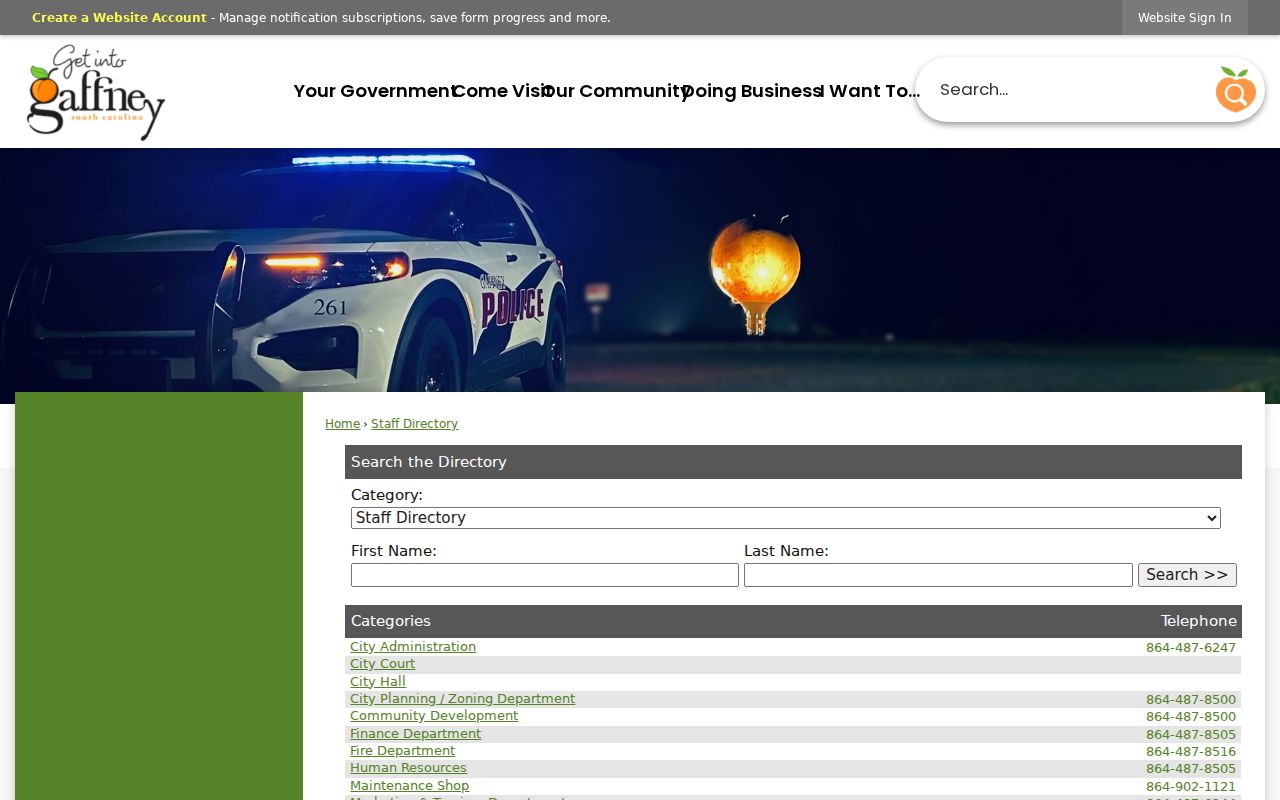
The official Gaffney Police Department page shows the local office and department structure.
The shared address is convenient, but it does not merge the records. Ask police for the report narrative and the court for the docket or disposition.
Records at the Gaffney Police Department
Gaffney Police records begin with what an officer documents. That may include an incident report, arrest report, investigation material, citation, or an identifying incident number. State law can protect parts of an active investigation, confidential methods, private identifiers, juvenile material, and information that could put a person at risk. Gaffney should still separate releasable material from exempt content when that can be done.
Describe the Gaffney record with a date range, event location, report type, and case or incident number when known. Include a preferred format and ask for a cost estimate. A narrow request helps city staff locate the right file and may reduce search and redaction time. If a Gaffney arrest was made by the sheriff, Highway Patrol, or another agency, request the narrative from that agency instead. The badge or citation heading usually identifies the creator.
Police do not issue the final court disposition. Once charges are filed, the court docket becomes the source for pleas, dismissals, findings, and sentences.
Gaffney Report or Court File
A Gaffney police report and a municipal case file answer different questions about the same Gaffney event. The report describes what the officer observed, what was reported, and what action police took. The Gaffney court file records the formal charge and what the judge did. Charges can change, and an arrest is not proof of guilt. Read the disposition, which means the recorded outcome, before drawing a conclusion.
| Gaffney source | Best use | Key limit |
|---|---|---|
| Police Department | Incident narrative, arrest report, and agency-created records | Does not establish the final case result |
| Municipal Court | Citation, docket activity, disposition, and certification | Covers only matters within city court authority |
| County detention | Current adult booking or custody confirmation | Not a full Gaffney criminal history |
| SLED CATCH | Fingerprint-supported South Carolina history | Excludes warrants and police narratives |
A Gaffney record check may need two of these sources. Use the report to understand the event and the docket to verify how the charge ended.
Booking and Arrest Records in Gaffney
Gaffney does not operate the adult booking search used for city arrests. A municipal-prisoner housing agreement, in place since 1997, sends adult Gaffney and Blacksburg prisoners to Cherokee County. The documented fiscal-year 2025 daily rate was $40.74. That arrangement explains why a person arrested by Gaffney Police may appear in the county detention system rather than a city jail log.
Use the official Cherokee County inmate roster for current county custody. If the roster fails, call the Detention Center at 864-487-2529. A releasable booking record can also be requested from the Cherokee County Sheriff at 312 East Frederick Street. The Gaffney Police report still comes from the city. The Cherokee County arrest search gives the county-level channel details without changing which office owns the Gaffney police narrative.
Absence from a current roster means only that the person is not shown in current county custody. It does not prove there was no past Gaffney arrest.
Where Gaffney Tickets Are Filed
The issuing agency and the place of the offense help identify the right Gaffney court. Gaffney Municipal Court handles traffic and criminal misdemeanors plus city-ordinance citations issued inside Gaffney by Gaffney Police. A Highway Patrol or Cherokee County Sheriff ticket does not become a city court record merely because the stop occurred near Gaffney. Those matters route to Cherokee Magistrate, whose main line is 864-487-2533.
This split is a common source of failed requests. Read the agency name and court line on the ticket before calling. If the document says Gaffney Police and identifies the city court, contact the municipal clerk. If it identifies a state trooper, deputy, magistrate, or bond court, start with the county summary-court channel. More serious filed charges may move to General Sessions at the Cherokee County Courthouse.
Note: A Gaffney mailing address does not determine court custody; the issuing agency and charged jurisdiction do.
The Gaffney Municipal Court File
Gaffney Municipal Court sits at 201 North Limestone Street and may be reached at 864-487-8524. The clerk counter is open Monday through Thursday from 8:15 a.m. to 5:15 p.m. and Friday from 8:15 a.m. to 12:30 p.m. The phone may confirm a case status or date, but Gaffney does not take a record order by telephone. Use the written records process for copies and certified results.
The official Gaffney Municipal Court page identifies the city court and its contact route.

The city court image marks the custodian for the case file, not for the underlying police report or county booking.
| Court Name | Gaffney Municipal Court |
|---|---|
| Case Types Heard | Authorized traffic and criminal misdemeanors and city-ordinance citations issued inside Gaffney by Gaffney Police |
| Case Lookup Channel | Written city court records request, clerk counter, or phone for status and date |
| What the File Shows | Citation or charge, case activity, disposition, and related court record |
| Copies & Fees | $0.50 per page; $5 certification plus pages; $5 disposition with photo ID; $32 recording media |
Order Gaffney Court Records
Use the official Gaffney Request for Records form for a city court file. Identify the requester, give contact information, and describe the case, person, or exact record. State whether ordinary copies, a certified record, a disposition, or recorded media are needed. Submit the form in person or by mail. Telephone orders are not accepted. In-person pickup requires photo identification, and payment is by cash or money order.
| Requested Gaffney item | Published amount or rule |
|---|---|
| Paper copy | $0.50 per page |
| Certified copy | $5 each, plus page charges |
| Disposition | $5 and photo ID for in-person pickup |
| CD or flash-drive recording | $32 |
Ask the clerk to confirm the total before sending payment. A request for a police narrative should go to Gaffney Police, even when a related municipal case exists.
Gaffney Court Retention Limits
Some older Gaffney municipal records are no longer available under the court form’s published retention limits. Traffic files older than five years, DUI files older than ten years, and criminal files older than fifteen years are listed as unavailable categories. These cutoffs apply to the Gaffney Municipal Court request path. They do not prove that every trace of the event vanished from all agencies.
If a city court file falls outside the stated period, check whether a related county court matter exists and ask the proper clerk about its archive. A statewide SLED CATCH report may contain a fingerprint-supported arrest cycle if SLED received and matched the data. Conversely, a SLED result is not a substitute for a certified Gaffney disposition. The product and the retention rule remain distinct.
Call the Gaffney municipal clerk before paying for a request near a cutoff. Provide the date and type of case so staff can identify whether the Gaffney record is still retained. When a file has aged out, ask whether the clerk can confirm that fact in writing and whether another Gaffney or Cherokee County custodian may hold a related record. A police report, booking entry, and court file can have different retention paths because each was created for a different purpose. Do not assume the city court’s limit controls every copy elsewhere.
How Gaffney Records Reach the County
A Gaffney officer creates the city police report. If an adult is taken into custody, Cherokee County detention creates the booking entry and LiveScan sends fingerprints electronically to SLED and the FBI. The city court keeps qualifying municipal matters. Charges outside that court’s authority move through the magistrate or the Court of General Sessions, and the court’s reported disposition should complete the SLED arrest cycle.
Record flow: Gaffney Police Department › Cherokee County Courts › South Carolina Law Enforcement Division
The timing of that flow affects a Gaffney search. A recent event may exist first as a city report and county booking. The court result can appear later. SLED warns that missing fingerprints or unmatched dispositions can leave gaps, so compare the city record with the court outcome rather than relying on one source.
Gaffney Records and County History
Gaffney is both the county seat and Cherokee County’s only city. Its court and police office sit near the county courthouse and law-enforcement complex, yet the files remain divided by custodian. That local layout grew with a county formed in 1897 from parts of Union, Spartanburg, and York counties. Modern record searches now cross city, county, and state systems even though many offices remain close together downtown.
The official Cherokee County history page places Gaffney within the county’s civic and historical setting.

That history helps explain the courthouse-centered geography, but current access still turns on which Gaffney office created each record.
A short walk between Gaffney offices does not replace a correctly addressed request. Use the Gaffney police channel for officer-created material, the Gaffney court form for its municipal file, and county offices for detention or General Sessions records. Keeping those boundaries in view saves time and preserves the meaning of each record.
Gaffney Record Access Rules
The South Carolina Freedom of Information Act applies to releasable Gaffney city records. For records less than 24 months old, the public body must give written notice of its determination within ten business days. The period is twenty business days for older material. A determination is not the same as production. Once access is granted, production generally follows within 30 calendar days, or 35 days for older records. The agency may require a deposit of up to 25 percent of the expected cost.
Key Statutes:
S.C. Code §30-4-30 sets the public inspection process, response periods, deposits, and actual-cost fee rules.
S.C. Code §30-4-40 permits specific exemptions, including protected law-enforcement information, while allowing nonexempt portions to be separated.
S.C. Code §23-3-120 requires custodial fingerprints and associated data to be sent to the state repository.
S.C. Code Title 14, Chapter 25 defines South Carolina municipal court authority.
Gaffney may withhold protected juvenile data, private identifiers, and active-investigation details that meet a statutory exemption. Requesters should ask for all reasonably separable public portions. Court records that have been lawfully expunged are not ordinary public files.