
Cherokee County Criminal History Checks
A Cherokee County record check begins by defining the answer you need. The South Carolina Judicial Branch Public Index holds case activity. The detention roster shows present or recent county custody. SLED CATCH compiles fingerprint-supported South Carolina arrest and disposition history. The state registry, SCDC locator, and probation office each maintain a narrower product. No single result stands for the whole criminal record.
Gather the full name, date of birth, possible spelling variants, and any known case or booking number. A case number is far more precise than a common name. Cherokee County uses county code 11 within the Judicial Branch case-number pattern. When a search result lists a charge, keep reading until the disposition line. A charge records an allegation, not the outcome.
- Choose the Public Index for a filed case, the jail roster for custody, or SLED CATCH for statewide history.
- Enter the most exact identifiers the official form permits and narrow the court, year, or record type.
- Open the detail view and compare the case number, agency, dates, and status before treating it as a match.
- Read the court disposition and sentence separately from the arrest or booking charge.
- Ask the proper clerk or agency for a certified copy when a screen result is not enough.
The Cherokee County government directory identifies the local offices that hold source records.
The directory matters because Cherokee County routes court, sheriff, detention, and general county records to different custodians.
Why Cherokee Criminal Record Searches Fall Short
Three products often get confused. A Public Index case file describes a prosecution, including its charges, docket events, disposition, and sentence. A county booking record describes intake and custody. SLED CATCH links fingerprint-supported arrest cycles with dispositions reported to the state repository. The state product omits wanted-person and registry searches, while the court file may omit an arrest that never became a filed case.
| Official channel | Best use | Important limit |
|---|---|---|
| Cherokee Public Index | Filed charges, actions, outcome, sentence | Not a complete arrest history |
| Cherokee detention roster | Current or recent county custody | Does not prove the final case result |
| SLED CATCH | Fingerprint-supported South Carolina history | No warrants or sex-offender results |
| SCDC Inmate Search | Current sentenced state prisoners | Excludes county jail and supervision |
The Judicial Branch Cherokee court directory shows where each local court sits and how to reach it.
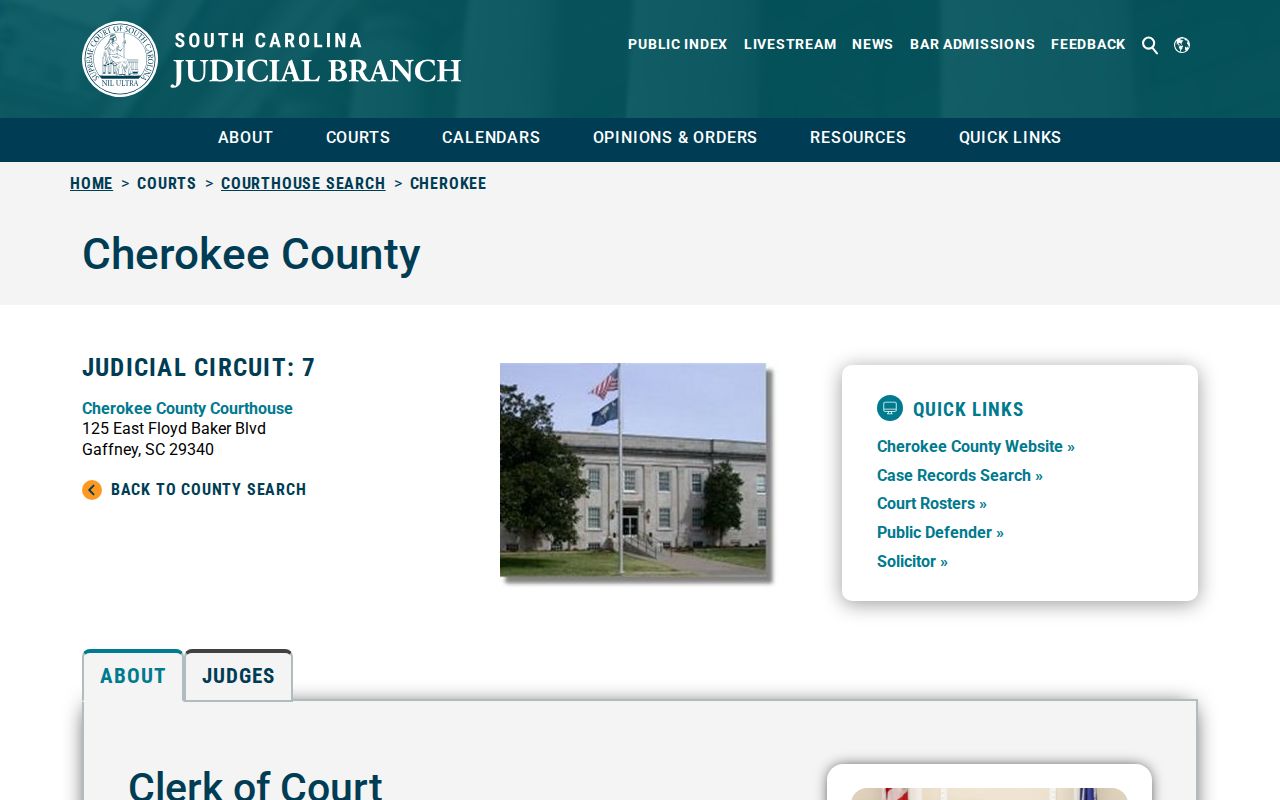
That court list is the practical bridge from an online result to the clerk who can provide the source file.
Federal matters form another layer. The District of South Carolina and PACER, not a county office, hold federal dockets. The federal district court site identifies that separate court system.
A federal search should supplement, not replace, the Cherokee County and South Carolina record channels.
Official Background Checks in South Carolina
The South Carolina Law Enforcement Division operates CATCH, Citizens Access to Criminal Histories. A member of the public may use the guest path for a state-only name check. The nonrefundable report price is $25. The portal also posts a processor fee of $1.43 per $25 report effective July 1, 2026. A mail request avoids the online convenience charge but requires the official form, qualifying payment, and a self-addressed stamped envelope.
Name and date-of-birth matching can join the wrong person or miss a spelling variation. SLED says fingerprints are the most reliable identity method, but fingerprint-based checks are limited to purposes authorized by law. Local law enforcement or a commercial provider can take prints. SLED names IdentoGO and its Print and Go service, while the FBI offers a separate fingerprint-based Identity History Summary to the subject of the record.
| Product | Identity method | Published cost |
|---|---|---|
| SLED CATCH online | Name, date of birth, optional SSN | $25 plus posted processor charge |
| SLED CATCH mail | Biographical form | $25 |
| Qualified charitable check | Verified account category | $8 plus posted service fee |
| FBI Identity History Summary | Subject fingerprints | Verify on the FBI order screen |
SLED CATCH and Cherokee Criminal Records
CATCH begins with an account choice. A private user can continue as a guest. The search requires last name, first name, date of birth, acceptance of the terms, and payment. A Social Security number is optional, but SLED searches it when supplied. The name fields use starts-with matching. Several possible subjects can trigger special processing rather than an instant, exact identity claim.
The official CATCH terms and search entry state both the scope and the exclusions.
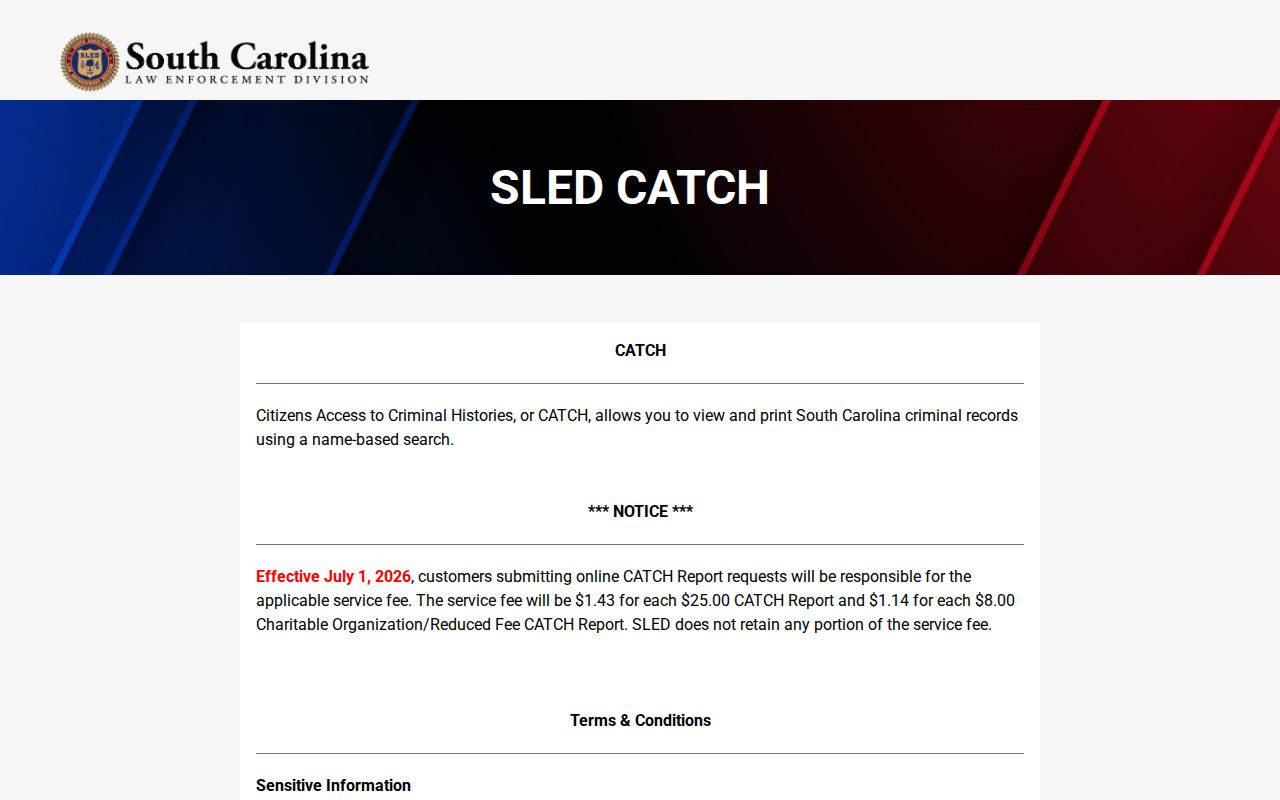
The screen makes clear that CATCH covers South Carolina records and does not include wanted-person or registry searches.
| Search field | Required | Use |
|---|---|---|
| Last name | Yes | Starts-with identity match |
| First name | Yes | Starts-with identity match |
| Date of birth | Yes | Separates similar names |
| Social Security number | No | Searched if voluntarily entered |
| Terms acceptance | Yes | Required before purchase |
The CATCH user-type screen separates the guest and account paths.
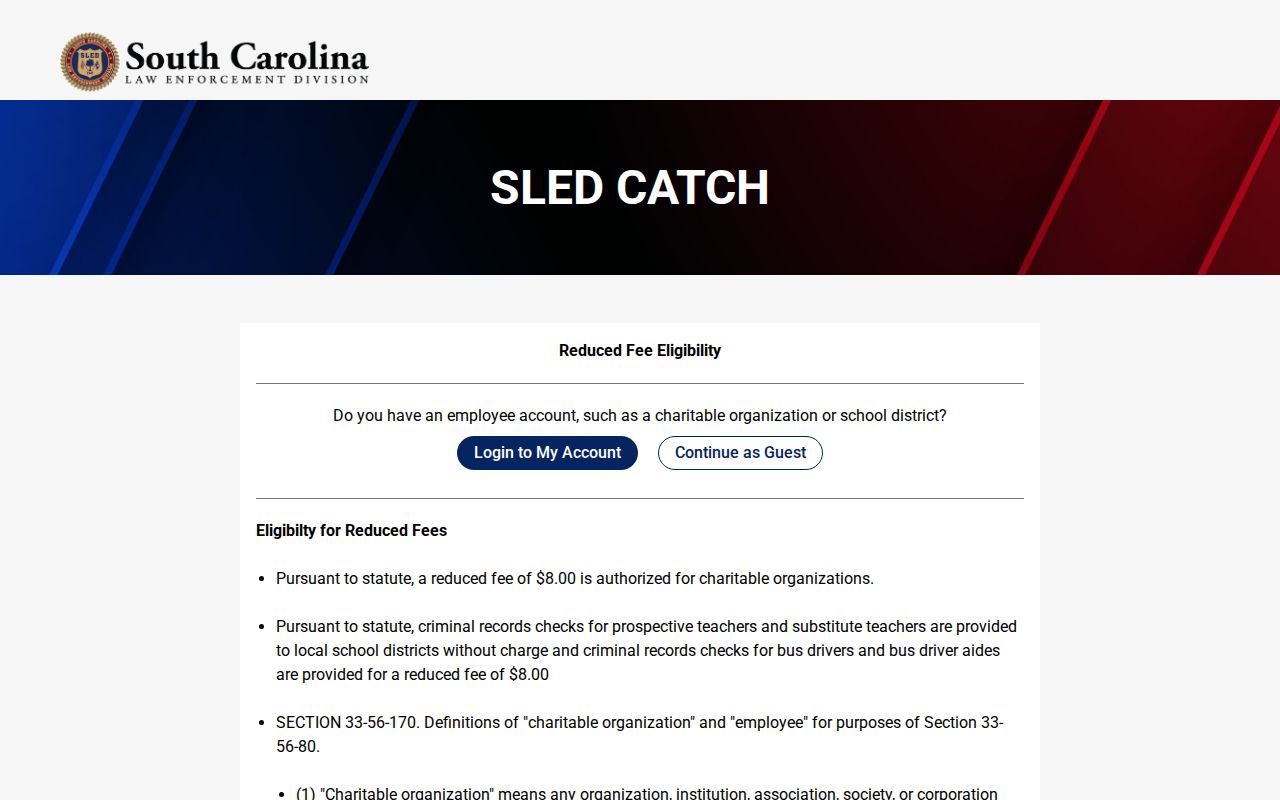
A one-time self-review normally begins with the guest option, while qualified reduced-fee users must meet the portal's account rules.
Kinds of Criminal Records
Record type determines the custodian. Cherokee County law enforcement creates incident and arrest reports. Detention staff create booking and custody entries. Magistrate and municipal courts create summary-court files, while the Clerk of Court keeps General Sessions matters. SLED builds a statewide criminal-history file from fingerprint and disposition submissions. SCDPPPS keeps supervision files, and SLED operates the sex-offender registry with local verification by the sheriff.
- Arrest and incident reports describe the agency's response and alleged conduct.
- Booking records show intake, presented charges, bond, and custody facts that were recorded at the jail.
- Court case files preserve filed charges, docket events, orders, dispositions, and sentences.
- Warrants come from an issuing court and do not appear in CATCH.
- State history and supervision records cover repository and sentence stages that county files do not.
These boundaries also explain why an arrest label can differ from a later indictment or conviction. The Cherokee County court case file follows the filed charge through its outcome.
Cherokee Booking Records Reach SLED
The Cherokee County Detention Center uses LiveScan rather than ink cards. During booking, the system captures fingerprints electronically and sends them to SLED and the FBI. County research states that a history match may return within 15 minutes to one hour. That process links a person to the arrest cycle more reliably than a name alone, but it still depends on the fingerprint submission and later disposition reporting.
The chain is straightforward: arresting agency report › detention booking and LiveScan › court charge and disposition › SLED repository update. A missing fingerprint can keep an arrest cycle out of the Computerized Criminal History. A missing or mismatched disposition can leave an arrest without its final outcome. The county jail record, court docket, and SLED report should therefore be compared when accuracy matters.
Record chain: Cherokee County detention can confirm custody, the proper clerk confirms the case result, and SLED handles challenges to its statewide history.
Note: A clean search in one system proves only that the record was not found in that system at that time.
Cherokee County Criminal Records: What They Contain
A useful Cherokee County criminal record result identifies both the event and its status. Names and aliases help locate a file, but a case number, booking number, date, and agency provide stronger anchors. Charges should be tied to the cited offense and the court that received them. The disposition tells whether the charge ended in conviction, dismissal, nolle prosequi, acquittal, no-bill, or another result.
| Name & Identifiers | Name, aliases, date of birth, and agency identifiers when public. |
|---|---|
| Arrest / Booking Data | Arrest date, booking date, arresting agency, presented charge, bond, and custody status. |
| Charges & Statutes | Filed offense, charging document, court, and statutory reference. |
| Disposition | The recorded outcome for each charge, not merely the case status. |
| Sentence | Custody, probation, fines, restitution, and other ordered conditions where public. |
| Custody / Supervision | County detention, state prison, probation, parole, or release information from the proper source. |
- Disposition
- The recorded outcome of a charge or case.
- Nolle prosequi
- A prosecutor's formal decision not to proceed with a charge at that time.
- No bill
- A grand jury's decision not to return the proposed indictment.
- Arraignment
- The hearing where the charge is formally presented and a plea is taken.
Cherokee Warrants Need a Separate Record Check
No verified public Cherokee County active-warrant database was found. The sheriff app does not advertise a warrant search, and SLED CATCH expressly excludes wanted-person data. The safe route is to call the Sheriff's Office or nonemergency dispatch, identify the issuing court, and check the related case. Cherokee Magistrate and Bond Court, Gaffney Municipal Court, Blacksburg Magistrate, and Blacksburg Municipal Court each may hold a piece of that trail.
A bench warrant often follows a failure to appear or obey a court order. An arrest warrant rests on a probable-cause finding. A search warrant authorizes a search of a place or item and is not a public person-lookup tool. Sealed, juvenile, and unserved material may remain unavailable. Anyone planning to appear should confirm the identity, issuing court, and surrender or bond instructions first.
The official Sheriff app offers tips, crime reporting, public-safety information, and news. It is not an emergency channel and is not proof of an app-only warrant tool.
South Carolina Public Access Laws
The South Carolina Freedom of Information Act creates an inspection and copy process for public records. It does not turn every law-enforcement file into an open record. Active-investigation details, protected victims, juvenile material, confidential sources, and information that would endanger someone may be withheld. A custodian should separate exempt material and release the public portion when the law permits.
Key South Carolina statutes:
S.C. Code §§30-4-30 and 30-4-40 set request timelines, actual-cost fee rules, and public-record exemptions.
S.C. Code §§23-3-115 and 23-3-120 govern SLED dissemination and fingerprint submission to the repository.
S.C. Code §17-1-40 directs record destruction after listed favorable outcomes, subject to its conditions.
S.C. Code §22-5-910 provides one route for a qualifying first summary-court conviction.
A request for a recent record receives a written determination within ten business days; an older record receives one within twenty business days. That response is not always production. Once available, production generally follows within 30 calendar days, or 35 for older records. An agency may require a deposit up to one-quarter of the expected cost.
Cherokee County Record Requests Split by Office
Cherokee County does not use one FOIA inbox for all criminal records. Sheriff incident, arrest, and booking requests go to the Sheriff's Office. General Sessions files go to the elected Clerk of Court. Gaffney Police and Blacksburg Police retain reports they created. E911 records use the county's E911 route. A precise request should name the record, agency, date range, incident or case number, location, and preferred format.
The county FOIA routing page separates sheriff and clerk records from ordinary department requests.
The routing page prevents a common delay: sending a criminal record request to County Administration when an independent custodian holds the file.
Cherokee County Clerk of Court
125 E. Floyd Baker Blvd., Gaffney, SC 29340
864-487-2571
Monday through Friday, 8:30 a.m. to 5 p.m.
Cherokee County Sheriff's Office
312 E. Frederick St., Gaffney, SC 29340
864-489-4722
Call before visiting for records-counter rules.
Cherokee County Detention Center
315 E. Dr. L. M. Rosemond Lane, Gaffney, SC 29340
864-487-2529
Current custody and booking fallback.
Restricted, Sealed & Expunged Records
South Carolina uses expungement and an Order for Destruction of Arrest Records for eligible matters. A dismissal, nolle prosequi, no-bill, or not-guilty result may fall under the favorable-outcome process, subject to statutory exceptions. General Sessions work runs through the Seventh Circuit Solicitor. A dismissed magistrate or municipal charge begins with that summary court. Juvenile files, protected victim details, personal identifiers, and properly expunged records are not ordinary public-index material.
Other routes are narrow. They include qualifying first summary-court convictions, certain drug dispositions, youthful-offender relief, fraudulent-check matters, and specified diversion programs. Eligibility depends on the exact charge and full history. A common paid application bundle is a $250 solicitor fee, $25 SLED verification fee, and $35 clerk filing fee, each handled as the official packet directs. Some favorable outcomes and documented waivers do not use that full bundle.
After a signed order reaches SLED, the agency says to allow four weeks and purchase a new CATCH report to confirm the change. A court outcome and a completed repository update are separate events.
Cherokee's 2026 Criminal Record Gap Pilot
Direct indictments can begin in court without an earlier custodial fingerprint event. In July 2026, SLED reported that only seven percent of the direct indictments it reviewed for the relevant period had reached the repository. Cherokee was among the circuits receiving scanners and training to capture fingerprints at the courthouse. The project targets a specific gap between a court case and the statewide history.
The SLED CJIS repository guidance explains the criminal-history lifecycle and correction process.
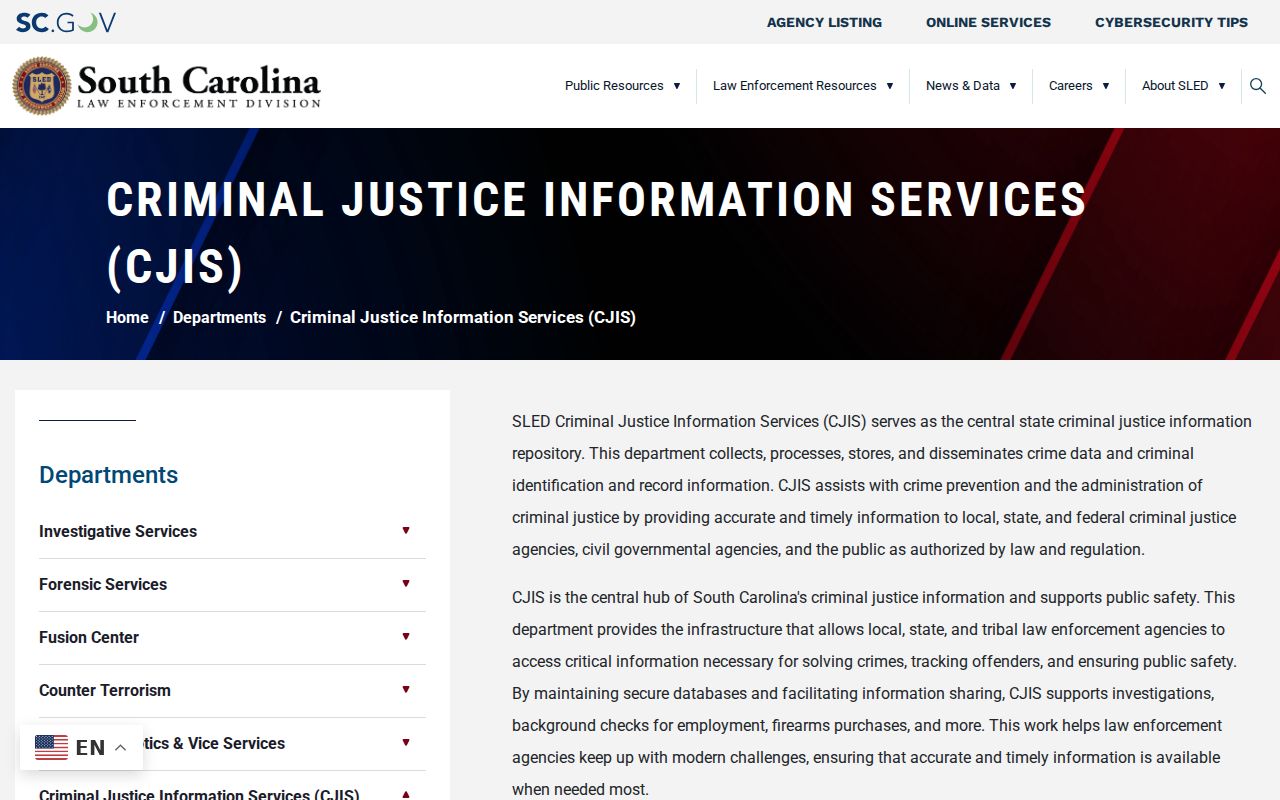
The correction path matters when the court file and CATCH report disagree. The person whose record is at issue can challenge the SLED entry and support the correction with source documents.
That pilot also gives a plain warning: database absence is not always proof that an event never occurred. Compare the court docket, booking source, and state history before drawing a conclusion.
Cherokee Custody Records Change Locators
Cherokee detention holds people awaiting trial, local prisoners, and sentences of 90 days or less. Its official Zuercher roster and the detention phone are the first checks for recent county custody. SCDC Inmate Search instead covers people currently sentenced to state prison. Its data reflect the prior midnight and exclude released people, county detainees, probation, parole, juveniles, and current fugitives.
SC VINE adds custody status inquiry and notification. SCDPPPS, not SCDC, handles probation and parole. The sentencing docket remains the source for the court's original order. Moving from county jail to state prison therefore changes both the custodian and the meaning of a search result.
Note: Absence from Cherokee detention means only that the person is not shown in current county custody.
Cherokee Supervision Records at West Buford
South Carolina organizes probation and parole at the state level. The Cherokee SCDPPPS office is at 113 West Buford, Suite C, Gaffney, and can be reached at 864-489-4568. Its July 31, 2026 snapshot listed 939 people on probation, 21 on parole, 24 in community supervision, five in supervised reentry, and 22 under Jessie's Law tracking. Those figures describe supervision categories, not a count of new criminal cases.
The official Cherokee supervision office page supplies the local contact and current category counts.
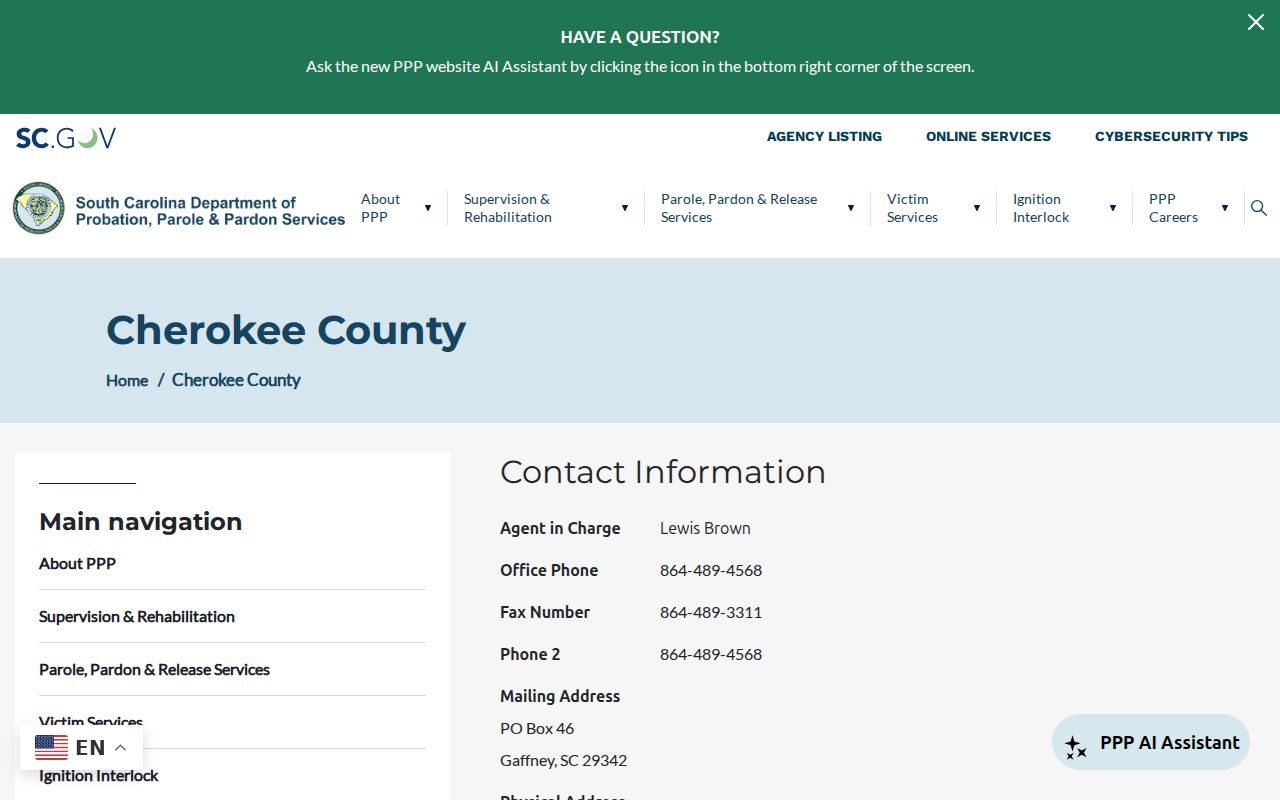
The public offender search uses combinations of name, SID number, county, and birth year. Its information is a previous-day view, and former supervisees may not appear. Private officer notes and operational files do not become public merely because a court sentence is visible.
City-by-City Criminal Records in Cherokee County
Cherokee County has two incorporated municipalities. Gaffney and Blacksburg each operate a police department and municipal court, but both send adult municipal prisoners to Cherokee County detention. A city police report stays with the city that created it. A booking moves to the county roster, and a General Sessions prosecution moves to the county clerk. That division makes the city record pages useful starting points without duplicating the full county record system.
Gaffney Record Check
Population 12,583 in the 2025 estimate. Police and Municipal Court share the North Limestone Street location.
Blacksburg Record Check
Town police records begin at South Shelby Street, while municipal and magistrate files share the West Cherokee Street court address.
Gaffney's court publishes a detailed request form and fee schedule. Blacksburg uses a signed town FOIA form submitted in person or by mail. Neither city published an official daily arrest blotter in the reviewed sources.